How Americans Handle Driving the Morning After a Night of Drinking
For many people, a hangover the morning after drinking is a consequence in itself, with headaches, nausea, dehydration, and a generally unwell feeling all common. But for people who get behind the wheel the morning after drinking, the repercussions can be more serious.
Research has found that driving with a hangover can still measurably impair driving ability, even after a person’s blood alcohol concentration (BAC) has returned to 0.00% or dropped to a low level. In one study, participants who experienced impaired driving performance had either a 0.00% BAC or an average BAC of 0.047%. We surveyed over 1,000 Americans about their habits and experiences with driving the morning after drinking, and the results revealed key insights into how drivers perceive and manage the risks associated with alcohol use.
Key Findings
- 40% of Americans regularly drive the morning after a night of drinking.
- 93% of Americans feel confident in their ability to determine when they’re ready to drive after a night of drinking.
- The majority of Americans determine if they’re ready to drive solely based on how they feel; fewer than 2% use a breathalyzer or BAC calculator.
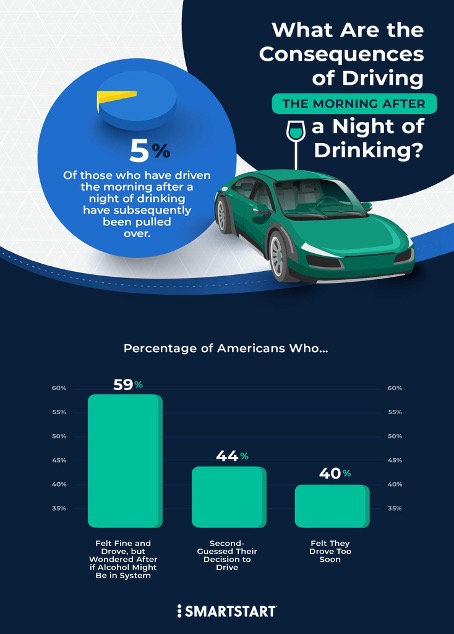
- 44% of Americans have second-guessed their decision to drive the morning after drinking, and 40% felt they drove too soon.
When and Why Americans Drive the Morning After
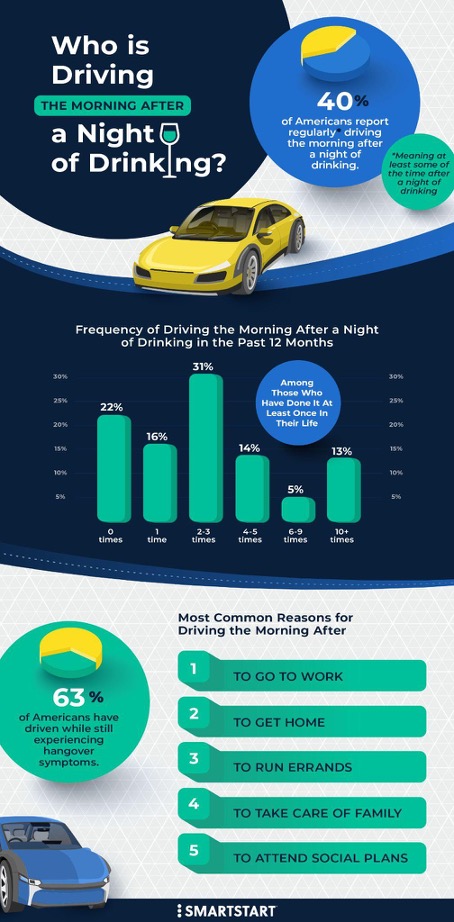
To start, we wanted to find out who was driving the morning after, and why. We found that 40% of Americans reported they regularly drove the morning after a night of drinking, with 18% reporting that they’d done so more than five times in the past year. In fact, 63% of Americans have driven while they’re still experiencing the physical symptoms of a hangover.
Men (39%) and women (40%) were equally likely to report driving while hung over, and there was relatively little difference between generations: Millennials (41%) were slightly more likely to say they’d done it, compared to Gen X (39%) and Gen Z (37%).
The most common reason people reported driving the morning after drinking? Perhaps unsurprisingly, it was to go to work. Other reasons included getting home, running errands, and attending to family responsibilities.
Understanding Impairment
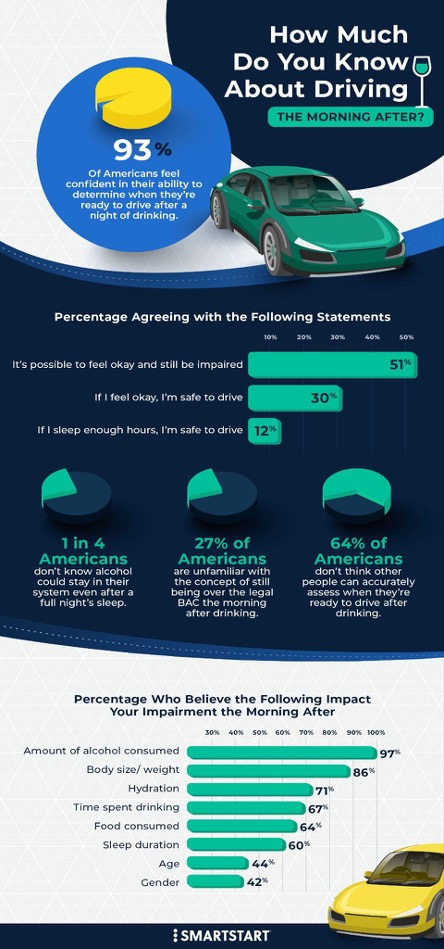
Many Americans trust their own judgment about driving the morning after drinking, with 93% reporting that they felt confident in their ability to drive after a night of drinking. When presented with the statement “It’s possible to feel OK and still be impaired,” 49 percent said they disagreed.
These findings highlight a common misconception about how long alcohol may affect driving ability. Alcohol can stay in a person’s system and have impairing effects even after a full night’s sleep, but 1 in 4 people surveyed didn’t know that. Plus, many people don’t get a full night’s sleep after drinking alcohol, especially since alcohol is known to disrupt sleep patterns.
Interestingly, while many respondents trusted their own judgment, 64% said they weren’t confident that other people could accurately assess when they’re ready to drive after drinking.
How People Decide They’re Ready to Drive
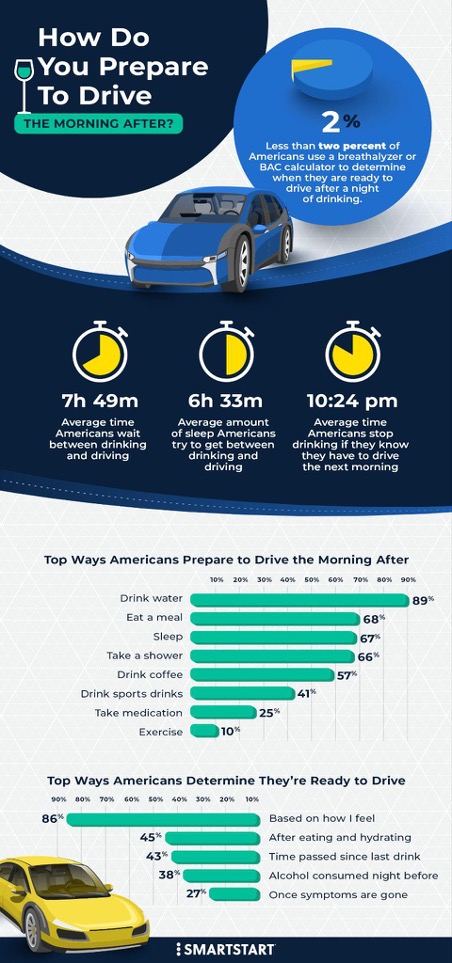
So how do people decide they’re ready to drive? In our survey data, respondents overwhelmingly chose “Based on how I feel physically.” However, many cited other factors like time since their last drink and how much alcohol they consumed the night before. Less than 2% said they used a breathalyzer or BAC calculator to determine whether they were in a safe condition to drive.
When morning comes, American drivers prepare to get behind the wheel in various ways. Drinking water, eating a meal, and sleeping are the top three most popular options. Those are indeed three of the most effective ways to reduce hangover symptoms, but they don’t actually clear any alcohol from your body. Time is the only reliable way for your body to eliminate alcohol.
Although fewer than 2% of respondents reported using a breathalyzer or BAC calculator, objective tools can offer more information than relying on physical symptoms alone. Portable breathalyzers may help estimate BAC, and Ignition Interlock Devices require a passing breath sample before a vehicle can be started.
Reflecting on Morning After Driving Decisions
What kind of experiences might come with a decision to drive the morning after? We asked our survey respondents if they’d ever regretted their decision to drive, or if they’d faced any consequences.
Many said they’d felt guilty or questioned themselves, with 44% second-guessing their decision to drive, and 40% reporting feeling that they drove too soon. And around five percent, or one in 20, said they had subsequently been pulled over. While we don’t have information about the outcome of those traffic stops, remember that depending on your state’s laws, you could still face DUI charges if alcohol-related impairment affects your ability to drive, even if your BAC is below the legal limit.
When People Choose Not to Drive
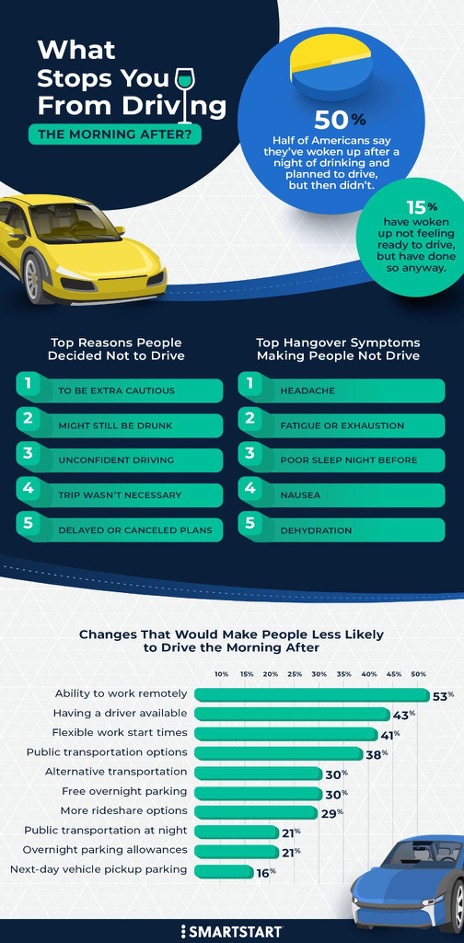
Not everyone drives the morning after drinking. Half of surveyed Americans reported that they experienced a time when they woke up after a night of drinking and planned to drive, but then didn’t. The reasons why included being extra cautious, thinking they were still buzzed and drunk, or simply deciding the trip wasn’t necessary. Among hangover symptoms, headache was the number one factor that caused people to avoid driving.
Conversely, 15% said they’ve woken up not feeling ready to drive, but did so anyway. Driving before alcohol has fully left your system can increase the risk of crashes and impaired decision-making.
So what helps people make the smart choice and stay off the road until they’ve allowed the alcohol to fully leave their system? In the survey, 53% said the ability to work the next day remotely would help them avoid driving after a night of drinking. Others pointed to designated drivers, flexible schedules, or transportation alternatives:
How to Prepare For Your Next Morning After
Despite the risks of driving the morning after drinking, it’s still a common habit among American drivers. Here are a few rules of thumb that can help you avoid risky situations:
- Consider avoiding alcohol if you have responsibilities the next day.
- Make alternative plans for getting home if you do choose to drink, such as rideshares or a designated driver
Smart Start helps drivers move forward safely after a DUI with Ignition Interlock Devices designed to prevent impaired driving. Whether you’re learning more about impairment or completing an Ignition Interlock program, we’re here with resources, knowledgeable Program Advisors, and judgment-free support every step of the way.
Methodology
We surveyed 1,272 Americans about their experiences with a night of drinking and then driving the morning after. We defined the morning after a night of drinking as “a morning after a night you drank enough alcohol to feel at least mildly intoxicated, buzzed, or affected by alcohol before going to sleep.” Additionally, we defined driving the morning after as driving within two hours of waking up.
Among our respondents, 55% were women, 43% were men, and 2% preferred not to say. Additionally, 11% were baby boomers, 45% were Gen X, 23% were millennials, and 21% were Gen Z.
Schedule an Installation
Get a quick and easy IID installation with Smart Start! Get started today!
¡Obtenga una instalación rápida y fácil de IID con Smart Start! ¡Empieza hoy mismo!
"* (required)" indicates required fields
Disclaimer