
America’s DUI Report Card
Most people know that driving drunk is against the law. Shockingly, that’s where the knowledge about DUI laws begins and ends for a lot of Americans.In the US, DUI laws are created at the state level, so they’re different in every state. Even the widely-known .08 BAC limit isn’t the law of the land everywhere. We decided to find out exactly what Americans know—or don’t know—about their state’s DUI laws.
To complete this study, we surveyed over 2,000 Americans across all 50 states to evaluate their knowledge and experience with their state’s DUI laws. Here’s what we discovered.
Key Findings
- On average, Americans score a C in their knowledge and experience of DUI law.
- North Dakota, Ohio, and New Mexico earned the highest grades when it came to DUI knowledge and experience. Hawaii, North Carolina, and Virginia earned the lowest.
- Nearly half of Americans don’t know the legal BAC limit for driving in their state.
- 1 in 3 Americans admit to having either knowingly or unknowingly operated a vehicle illegally while under the influence.
- 2 in 5 men have illegally operated a vehicle under the influence.
- Nebraska, Montana, and South Dakota had the highest rates of residents operating vehicles illegally under the influence, each being over 50%. North Dakota, New Mexico, and Utah had the lowest rates
America’s Overall Knowledge of DUI Laws

When it comes to DUI laws, too many Americans are content to go on vibes. The average respondent earned a C with just 76% correct on the test, indicating significant knowledge gaps in their understanding of DUI laws.
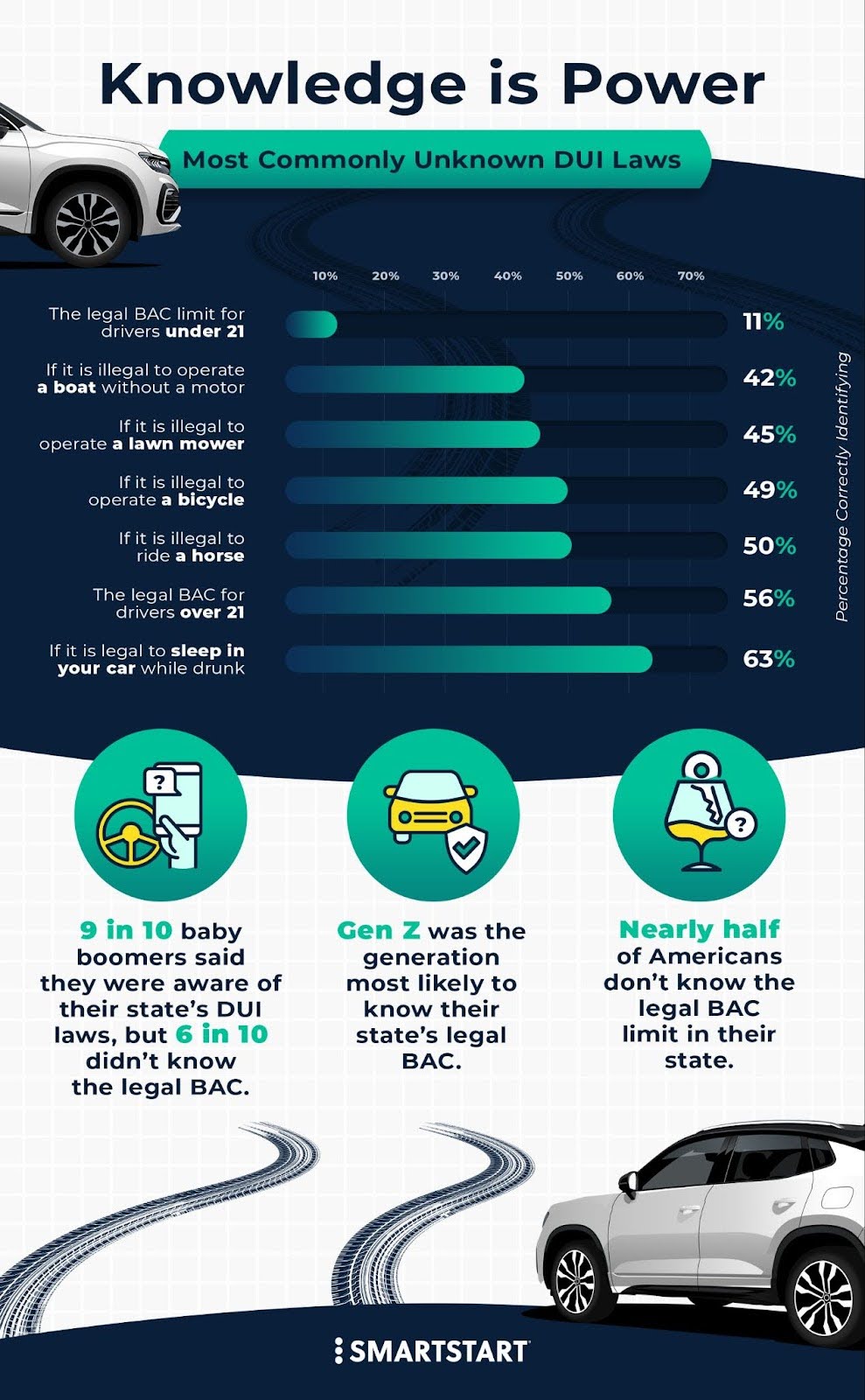
First, a sobering statistic (no pun intended): Nearly half of Americans don’t even know the legal BAC limit in their state. And when it comes to the legal BAC for drivers under 21, which is often somewhere between 0 and 0.02%, only 11% were able to identify it correctly. We can only hope these drivers are taking a “better safe than sorry” approach and not drinking alcohol at all before driving.
Generational differences became apparent here, with Gen Z being the most likely to know their state’s legal BAC limit. (Gen Z is also known for drinking less alcohol overall.) Meanwhile, baby boomers struggled with overconfidence: 9 in 10 said they were aware of their state’s DUI laws, but 6 in 10 couldn’t even correctly identify their state’s legal BAC for drivers.

Knowledge of DUI laws varied not only across genders and generations but also across states. North Dakota, Ohio, and New Mexico earned the highest grades when it came to DUI knowledge and experience. Hawaii, North Carolina, and Virginia earned the lowest.
Accidentally Breaking the Law
Finally, many drivers were shaky on exactly which vehicles are legal and illegal to operate while drunk. That’s not entirely surprising, given that state laws vary significantly in some cases. For example, you can get a DUI on a bicycle in most states but not all, while only a handful of states explicitly ban riding a horse while intoxicated. (For the record, both of those are terrible ideas, legal or not.)
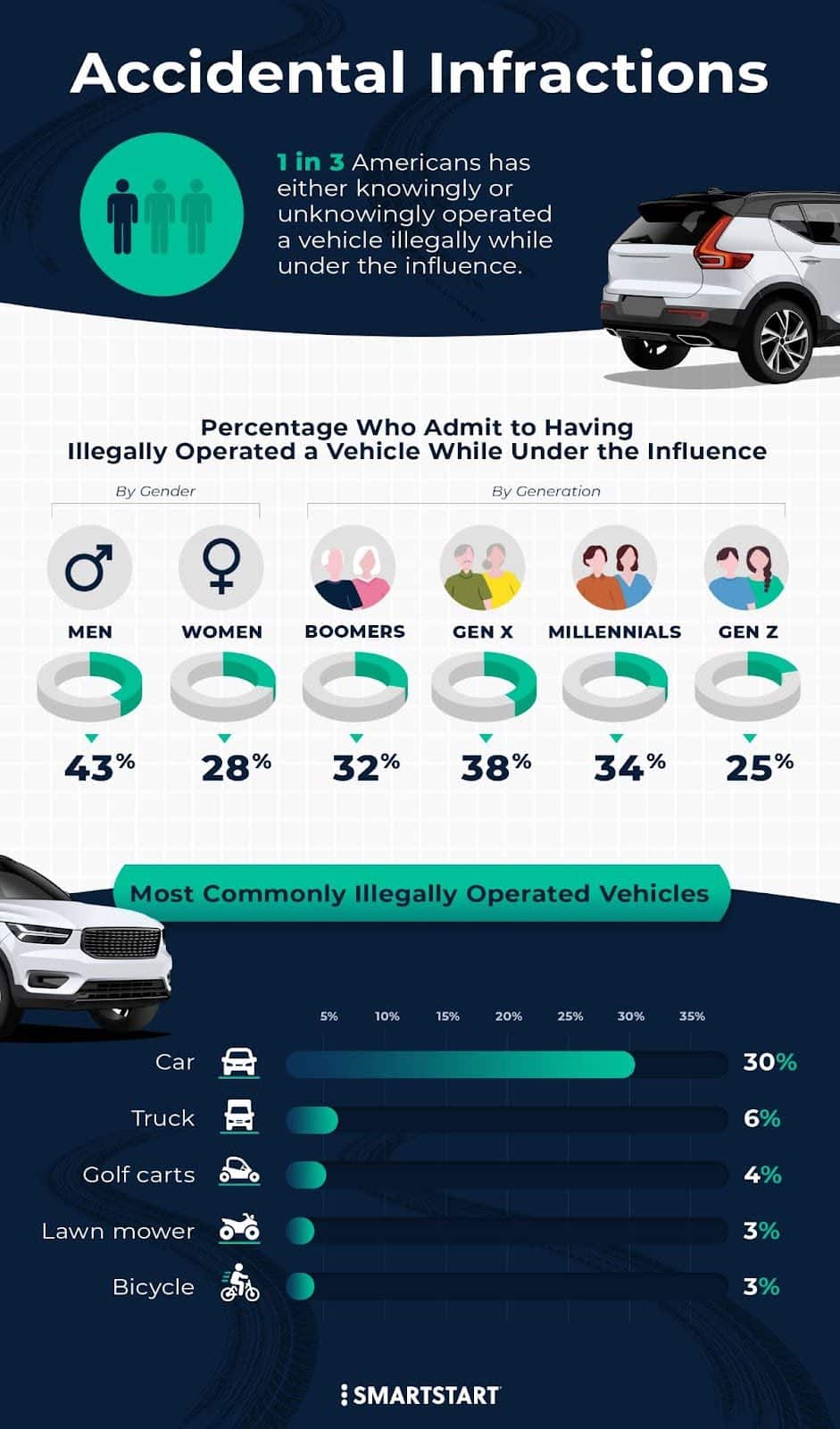
Unfortunately, 1 in 3 adults admitted to having operated a vehicle under the influence, either knowingly or unknowingly. And while that doesn’t tell us whether they did it once and regretted it or still do it today, even once is enough to bring on all the terrible consequences of drunk driving. A car was by far the most likely vehicle for drivers to say they’d operated intoxicated, with 30% admitting to it.
Gen X drivers were the most likely to have driven under the influence: 38%, or almost 4 in 10. Millennials and boomers follow, with Gen Z a distant fourth at only 25%. As attitudes toward drunk driving shift, we can hope that the number will keep dropping with each successive generation. Men were also significantly more likely to drive while intoxicated.
It’s also important to realize that, due to their limited knowledge of state laws, many of our respondents may not have known that what they did was illegal. That’s especially true for those who operated vehicles like bikes and lawn mowers that can fall into legal gray areas. So it’s critical to know exactly what the law says in your state—or, better yet, not to operate any vehicle with any level of alcohol in your system.

Given that DUI laws are different in many states, the logical next question is: Where is it happening the most?
Our data pointed to the Northern Great Plains, where over 50% of residents of Nebraska, Montana, and South Dakota said they had illegally operated a vehicle under the influence. Unfortunately, that’s especially unsurprising in South Dakota, which had America’s highest per capita DUI arrest rate in 2024. Montana, meanwhile, has one of the highest fatality rates in the country for drunk driving.
The states with the lowest rates? North Dakota, New Mexico, and Utah. The last of these three is consistently the state with the lowest alcohol consumption rates, as well as the only state where the legal BAC limit for driving is just .05%, rather than .08.

Across the nation, the most commonly illegally operated vehicle is a car—not surprising. Look a little closer, however, and you’ll see why a lack of awareness of local DUI laws can put drivers in a situation where they’re breaking the law without knowing it.
Many people riding a bicycle after a few beers in Florida probably don’t know that it’s against the law. The same likely goes for the respondents who told us about operating a tractor under the influence in Tennessee, or a snowmobile in Massachusetts.
Being unaware of the law won’t protect you from its consequences, however. The lucky ones will get off with a DUI charge, which is still better than a life-shattering collision.
Conclusion
While DUI laws can be startlingly different from one state to another, there’s one sure-fire way to avoid running afoul of any of them: Don’t operate any vehicle when you’ve been drinking alcohol. At Smart Start, we’re proud to help drivers with a DUI obtain an Ignition Interlock Device that gets them back on the road. The best choice is never to do it to begin with, however, so call a rideshare, get a ride with a sober friend, take public transit, or walk.
Methodology
We surveyed 2,282 Americans across all 50 states. We had statistically significant sample sizes for all states except Alaska and Wyoming, which were therefore excluded from state-level analysis. Among our respondents, 39% were men and 61% were women. Additionally, 8% were baby boomers, 33% were Gen X, 45% were millennials, and 14% were Gen Z.
In our survey, respondent had the opportunity to earn a total of 35 points, 19 based on their knowledge of their state’s DUI laws and 16 based on their experiences obeying those laws. The percentage of total points earned out of the available points was calculated. When determining grades, a curved scale was used to best exemplify the differences between scores. This means our highest scores were given an A+, the lowest scores were given an F, and the remaining scores were normalized in between.
Schedule an Installation
Get a quick and easy IID installation with Smart Start! Get started today!
¡Obtenga una instalación rápida y fácil de IID con Smart Start! ¡Empieza hoy mismo!
"* (required)" indicates required fields
Disclaimer